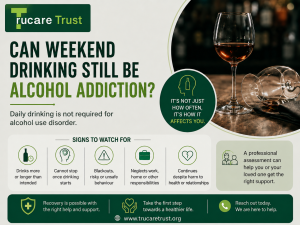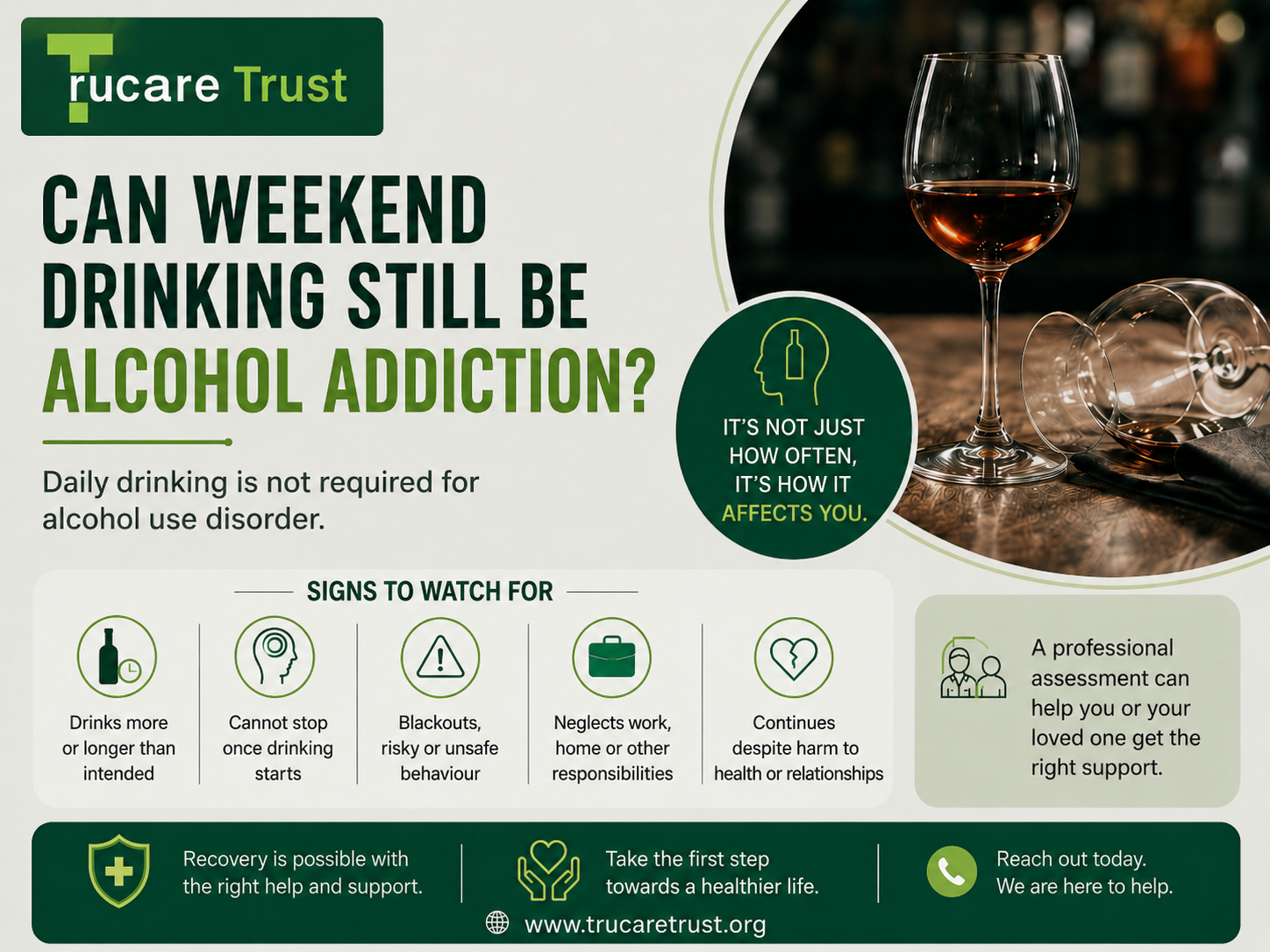
Yes. Weekend-only drinking can still become a serious alcohol problem. A weekend drinking addiction is not judged by the calendar alone. Concern rises when a person repeatedly drinks more than intended, cannot stop once started, experiences blackouts, takes unsafe risks, neglects responsibilities or continues despite harm. Families searching for a nasha mukti kendra in Mumbai should focus on loss of control, consequences, craving and withdrawal rather than assuming weekday abstinence proves safety. A clinical assessment can distinguish risky drinking from alcohol use disorder and guide the appropriate level of support.
The image of alcohol dependence as drinking from morning to night misses many harmful patterns. Some people work through the week, avoid alcohol for several days and then drink heavily from Friday evening onwards. Others plan two drinks but continue until late at night, lose parts of the evening from memory or need the next day to recover.
Drinking every weekend does not automatically establish a diagnosis. It does, however, create a repeated pattern that deserves attention when alcohol starts deciding plans, spending, relationships or safety. The question is not simply, “How many dry days are there?” It is also, “What happens before, during and after each episode?”
Daily drinking is not required for alcohol use disorder
Alcohol use disorder is a medical condition marked by difficulty controlling alcohol use despite harm. A clinician looks for a pattern over time, not a particular day of the week. Relevant features include drinking more or longer than intended, unsuccessful efforts to cut down, considerable time spent drinking or recovering, craving, hazardous use, role problems, tolerance and withdrawal.
The National Institute on Alcohol Abuse and Alcoholism explanation of alcohol use disorder lists the symptoms used in assessment. Severity depends on how many are present within a twelve-month period. Daily use is not a required criterion.
This is why alcohol addiction signs can appear in a person who remains alcohol-free from Monday to Thursday. Repeated failed limits, dangerous driving, arguments, injuries or missed responsibilities may be more informative than the number of drinking days. A person may also show a loss of control over alcohol only after the first drink, while appearing fully in control before the weekend begins.
The phrase weekend drinking addiction describes this concern in everyday search language, but it should not be used as a self-diagnosis. A careful assessment should examine the full pattern, physical health, mental health, medicines, other substance use and the risks around stopping.
Heavy episodes and a diagnosis are related but different
Binge drinking refers to a pattern in which alcohol is consumed quickly enough to raise blood alcohol concentration substantially. The NIAAA definition of binge drinking uses a blood alcohol concentration of 0.08% or higher. For a typical adult, this corresponds to about five or more U.S. standard drinks for a man or four or more for a woman in roughly two hours. A U.S. standard drink contains about 14 grams of pure alcohol. Actual serving sizes and alcohol strength vary considerably, so counting glasses, pegs or bottles without considering their alcohol content can be misleading.
A binge drinking problem may exist without alcohol use disorder, and alcohol use disorder may occur without every episode meeting a binge threshold. The two overlap, but they are not identical. Repeated intoxication still raises the chance of injury, vomiting, unsafe sex, violence, falls, crashes and alcohol overdose even when a diagnosis has not been made.
“Binge drinking disorder” is a popular search phrase, not a separate formal diagnostic label. The recognised diagnosis is alcohol use disorder, while binge drinking describes how alcohol is consumed. That distinction prevents an intense episode from being dismissed, but it also avoids diagnosing someone from one number or one evening.
The term weekend alcoholism is also non-clinical and can be stigmatising. It may hide the real questions: Is there impaired control? Is the pattern causing harm? Has the person tried and failed to change it? A person-first discussion is more useful than attaching a label.
What makes a weekend pattern concerning?
No single sign settles the question. Concern grows when several changes appear repeatedly, become more severe or continue after the person recognises the damage. The following signs of problem drinking deserve a calm discussion and, where appropriate, professional screening.
- Drinking begins earlier, lasts longer or involves more alcohol than planned.
- The person cannot reliably stop after the amount agreed with themselves or others.
- Friday or Saturday plans increasingly revolve around where alcohol will be available.
- Important family, study, work or religious commitments are missed because of drinking or recovery.
- There are blackouts, injuries, fights, unsafe travel, sexual risk or unexplained spending.
- The person becomes defensive, hides bottles, understates quantities or drinks before meeting others.
- Attempts to skip a weekend or reduce the amount repeatedly fail.
- Low mood, anxiety, poor sleep or irritability reliably follow the episode.
These alcohol addiction signs should be interpreted in context. One disagreement or hangover does not prove a disorder. Repeated consequences, however, should not be excused simply because the person reports to work on Monday. Professional success and weekday abstinence can coexist with serious harm.
Loss of control over alcohol may be seen when a planned single drink becomes an all-night session. It may also appear before drinking, through persistent alcohol cravings, difficulty thinking about anything else or repeatedly abandoning alcohol-free plans.
Why weekday abstinence can create false reassurance
Regularly going several alcohol-free days without withdrawal symptoms may make significant current physical dependence less likely, but it does not rule out alcohol use disorder or make repeated heavy drinking safe. The reported pattern may also miss alcohol used secretly, during leave, at night or to relieve emerging symptoms.
Weekday functioning can also hide the cost of weekend binge drinking. Sunday may be lost to nausea, anxiety or sleep. Monday concentration may be poor. A partner may spend the weekend managing arguments, transport, vomiting or childcare. These effects count even when no formal warning has been issued at work.
Social drinking problem is another imprecise expression. Drinking in a group does not make the pattern safe, and drinking alone does not by itself prove a diagnosis. The useful question is whether the social setting repeatedly permits or conceals harmful use.
Someone asking when drinking becomes addiction should look beyond appearances. The shift is not a single moment. It is a developing pattern in which choice narrows, attempts to control use fail and alcohol continues despite clear physical, psychological or social harm.
Quantity and pace can change risk within hours
Alcohol is absorbed faster than the body can clear it when large amounts are taken quickly. Strong mixed drinks, rapid refills and drinking games make the true amount difficult to judge. Drinking on an empty stomach can also make intoxication rise faster. Medicines and other substances may add sedation or other risks.
A binge drinking problem is therefore not measured only by the next morning’s hangover. During the episode, judgement, coordination and reaction time can deteriorate before the person recognises how impaired they are. A person may keep talking or walking while being unable to form new memories.
Memory loss after drinking may be a blackout, during which the person remains awake but later cannot remember events. It is different from becoming unconscious. Either situation is a warning sign, and difficulty waking a person is an emergency rather than something to “sleep off”.
| Area | What a family may hear | What needs closer assessment |
|---|---|---|
| Frequency | “Alcohol is used only on weekends.” | How often the person binges, loses control or needs days to recover |
| Quantity | “It was only a few glasses.” | Glass size, alcohol strength, refills, pace and mixing with other substances |
| Control | “Stopping is possible whenever needed.” | Repeated failed limits, unplanned continuation and inability to skip an occasion |
| Function | “Work is still going well.” | Effects on sleep, family, safety, finances, health and Monday performance |
| Physical risk | “There is no drinking during the week.” | Blackouts, vomiting, injuries, overdose signs, tolerance or withdrawal |
Tolerance can make heavy drinking look less serious
Alcohol tolerance means that a person needs more alcohol to feel an effect or feels less affected by an amount that previously caused intoxication. It is an adaptation, not protection. Someone who appears steady after several drinks may still have impaired judgement, unsafe blood alcohol levels and organ exposure.
Rising alcohol tolerance can quietly enlarge a weekend pattern. The person may buy stronger drinks, begin before meeting friends or add a second night because the earlier amount no longer produces the expected effect. Families may wrongly interpret the ability to “hold alcohol” as evidence of safety.
Physical dependence on alcohol means the body has adapted to regular alcohol exposure so that stopping or substantially reducing alcohol may produce withdrawal symptoms. Physical dependence is not required for alcohol use disorder, and alcohol use disorder can occur without obvious withdrawal. This is why a symptom checklist alone cannot determine whether stopping alcohol is safe.
Can withdrawal occur in someone who mainly drinks on weekends?
Many people who drink intermittently will not develop physical dependence. Yet the pattern can change over time, and the reported schedule may not capture alcohol used secretly, during leave, at night or to relieve morning symptoms. Previous withdrawal, repeated heavy episodes, poor health and sedative use can alter risk.
Alcohol withdrawal symptoms may include tremor, sweating, anxiety, nausea, disturbed sleep and a racing heartbeat. Severe confusion, hallucinations or seizures require urgent medical care. The NHS guidance on alcohol use disorder warns that suddenly stopping can be dangerous for a person who is dependent.
Do not tell a person with suspected alcohol dependence to prove control by abruptly stopping at home. Arrange an appropriate clinical assessment before a major reduction, especially after previous seizures or delirium, during pregnancy, with serious illness or when alcohol is combined with sleeping or anti-anxiety medicines.
Urgent safety note: Call 112 in India or go to the nearest emergency department if a person has a seizure or fit, severe confusion, hallucinations, collapse, unconsciousness, slow or irregular breathing, repeated vomiting with reduced alertness, chest pain, serious injury, suicidal intent or violence that cannot be managed safely. Do not leave an unconscious person alone or assume sleep will resolve alcohol overdose.
Blackouts and hangovers are not harmless rituals
A blackout indicates that alcohol disrupted memory formation. The person may speak, travel, spend money or have sex without later recalling it. Memory loss after drinking also makes it difficult to assess consent, injury and other events accurately. Repeated blackouts warrant medical and alcohol assessment.
A hangover is not the same as withdrawal. Headache, thirst, nausea, fatigue and sensitivity to light can follow intoxication without physical dependence. Alcohol withdrawal symptoms are more concerning when they emerge as alcohol wears off and are relieved by further drinking, although only a professional assessment can interpret the pattern.
Anxiety and shame after a weekend may lead to promises that the episode will never happen again. If the same cycle returns, the focus should shift from promises to evidence: quantities, triggers, failed limits, risks and consequences. This gives a clinician better information than labels or arguments.
Why “everyone drinks like this” is not a safety test
Group habits can normalise risk. If friends drink similar amounts, a person may view blackouts, vomiting or unsafe transport as ordinary. Yet health history, medicines and alcohol metabolism differ. Group acceptance cannot establish safety.
A social drinking problem often becomes visible when alcohol is required for every celebration, dinner or weekend gathering. The person may avoid events without alcohol or pressure others to keep drinking. These behaviours do not prove a diagnosis, but they show that alcohol has become central to social functioning.
Drinking every weekend may also intensify during holidays, salary days, sporting events or periods of stress. Recording the pattern for a few weeks can reveal frequency, approximate quantity, triggers and consequences. Records should support an honest conversation, not secret surveillance or punishment.
How a professional assessment answers the question
A qualified clinician or addiction professional will ask about more than quantity. Assessment may cover the age drinking began, typical and maximum amounts, pace, blackouts, injuries, driving, medicines, other substance use, sleep, mood, physical health and previous attempts to change.
Validated screening questions may identify risk, but screening is not diagnosis. The phrase binge drinking disorder should not replace a full assessment. A clinician must consider whether alcohol use disorder criteria are present, the severity and whether another condition changes the care plan.
The question of when drinking becomes addiction is answered through evidence of impaired control and continuing use despite harm, not moral judgement. Alcohol cravings, tolerance or withdrawal may add concern, but no single feature should be interpreted in isolation.
Families should describe observable events: “three blackouts in two months”, “drove after drinking”, or “missed two important commitments”. Statements such as “no self-control” or “weekend alcoholism” can provoke shame without helping assessment. Specific information supports a safer decision.
Does every concerning pattern require residential rehabilitation?
No. The appropriate setting depends on severity, withdrawal risk, physical and mental health, safety, home support, previous treatment and the person’s preferences. Some people may receive brief intervention or outpatient care. Others may need medically managed withdrawal, structured day treatment or residential rehabilitation.
Effective treatment for alcohol addiction can include psychological therapies, medication when clinically suitable, family support, peer or mutual support and continuing care. Detoxification addresses withdrawal; it does not by itself change triggers, coping patterns or the consequences that maintain drinking.
The Trucare Trust page on alcohol addiction treatment explains the service pathway available through the organisation. A person considering care should still receive an individual assessment rather than assuming a particular programme or duration is automatically appropriate.
It may also help to understand how assessment, withdrawal care, rehabilitation, discharge planning and continuing support serve different purposes. The guide to alcohol treatment stages explains why later care should not be replaced by a short detox episode.
Practical steps before the next weekend
If there is no immediate emergency, record recent episodes. Note what was consumed, when drinking started and ended, what the person intended and what happened afterwards. Include blackouts, injuries, unsafe travel and missed responsibilities.
Choose a calm time when nobody is intoxicated or severely hungover. Describe the events without name-calling. Ask what the person notices about alcohol cravings, failed limits and recovery time. The goal is to understand the pattern and arrange assessment, not to win an argument.
Do not use a confrontation to demand abrupt abstinence when physical dependence may be present. Seek clinical advice first if there are morning tremors, sweating, nausea, drinking to relieve symptoms, previous severe withdrawal, pregnancy, serious illness or mixed use with dependence-forming sedatives.
A person who is not ready for residential care may still agree to a medical appointment, screening or outpatient discussion. Treatment for alcohol addiction should be matched to risk and need. Engagement can begin with one honest assessment rather than a pressured promise about lifelong change.
Questions families frequently ask
Does drinking only on Saturdays rule out alcohol use disorder?
No. A diagnosis does not require daily drinking. A clinician considers impaired control, craving, hazardous use, role problems, continued drinking despite harm, tolerance and withdrawal over time. Someone who drinks on one day may still experience severe consequences or repeatedly fail to keep intended limits.
Is every weekend binge an addiction?
No. Binge drinking is a risky consumption pattern, while alcohol use disorder is a clinical diagnosis. A single episode does not establish the diagnosis. Repeated binges still deserve attention because intoxication can cause overdose, injury, unsafe decisions and other harm before dependence develops.
Can a person have a serious problem and still perform well at work?
Yes. Work performance is only one area of functioning. Harm may appear in health, sleep, relationships, finances, driving or caregiving first. Stable employment should be considered alongside the whole drinking pattern rather than treated as proof that alcohol use is controlled.
What does it mean if the person cannot remember the evening?
It may be an alcohol-related blackout, in which the person remains awake but cannot form lasting memories. Blackouts indicate substantial intoxication and increase vulnerability to injury and unsafe events. Difficulty waking the person, abnormal breathing, seizure or repeated vomiting with reduced alertness requires emergency help.
Can weekend use lead to physical dependence?
Intermittent use does not always cause dependence, but patterns can intensify and reported schedules may omit hidden drinking. Tolerance, morning symptoms, drinking to relieve discomfort or previous withdrawal need assessment. A person at risk should not be instructed to stop suddenly without appropriate clinical guidance.
Should the family count every drink?
An agreed record can clarify quantity, pace, triggers and consequences. Secret monitoring, searching or public confrontation can damage trust and may create safety risks. Families can focus on observable events and encourage an assessment while respecting the person’s dignity, privacy and lawful autonomy.
What if the person says the concern is exaggerated?
Avoid arguing about labels. Discuss specific events, such as blackouts, injuries, driving, failed limits or missed commitments. A neutral professional assessment can review both the person’s account and the family’s concerns. Immediate safety takes priority if there is overdose, severe withdrawal, self-harm or violence.
The calendar does not decide severity
Weekend binge drinking can be dangerous even when the person has several alcohol-free days. The clearest signs of problem drinking are repeated loss of control, rising risk and continued use despite consequences. Weekday abstinence is useful information, but it does not cancel what happens during intoxication or recovery.
Concern about weekend alcoholism should be translated into precise, non-stigmatising questions. What was planned? What was consumed? Could the person stop? What harm followed? Are alcohol cravings, alcohol tolerance or dependence features present? These answers give a clinician something reliable to assess.
A serious pattern can be treated. The safest next step is an assessment that distinguishes risky use, a binge drinking problem and alcohol use disorder, then matches support to the person’s clinical needs and circumstances.
Medical disclaimer: This article provides general educational information and does not replace individual medical assessment, diagnosis or treatment. A person with regular heavy alcohol use, previous withdrawal seizures or delirium, pregnancy, serious illness, mixed-substance use or significant mental-health symptoms should receive appropriate clinical assessment before stopping or substantially reducing alcohol. Call 112 in India or go to the nearest emergency department for a seizure or fit, severe confusion, hallucinations, collapse, unconsciousness, slow or abnormal breathing, chest pain, serious injury, suicidal intent or violence that cannot be managed safely.