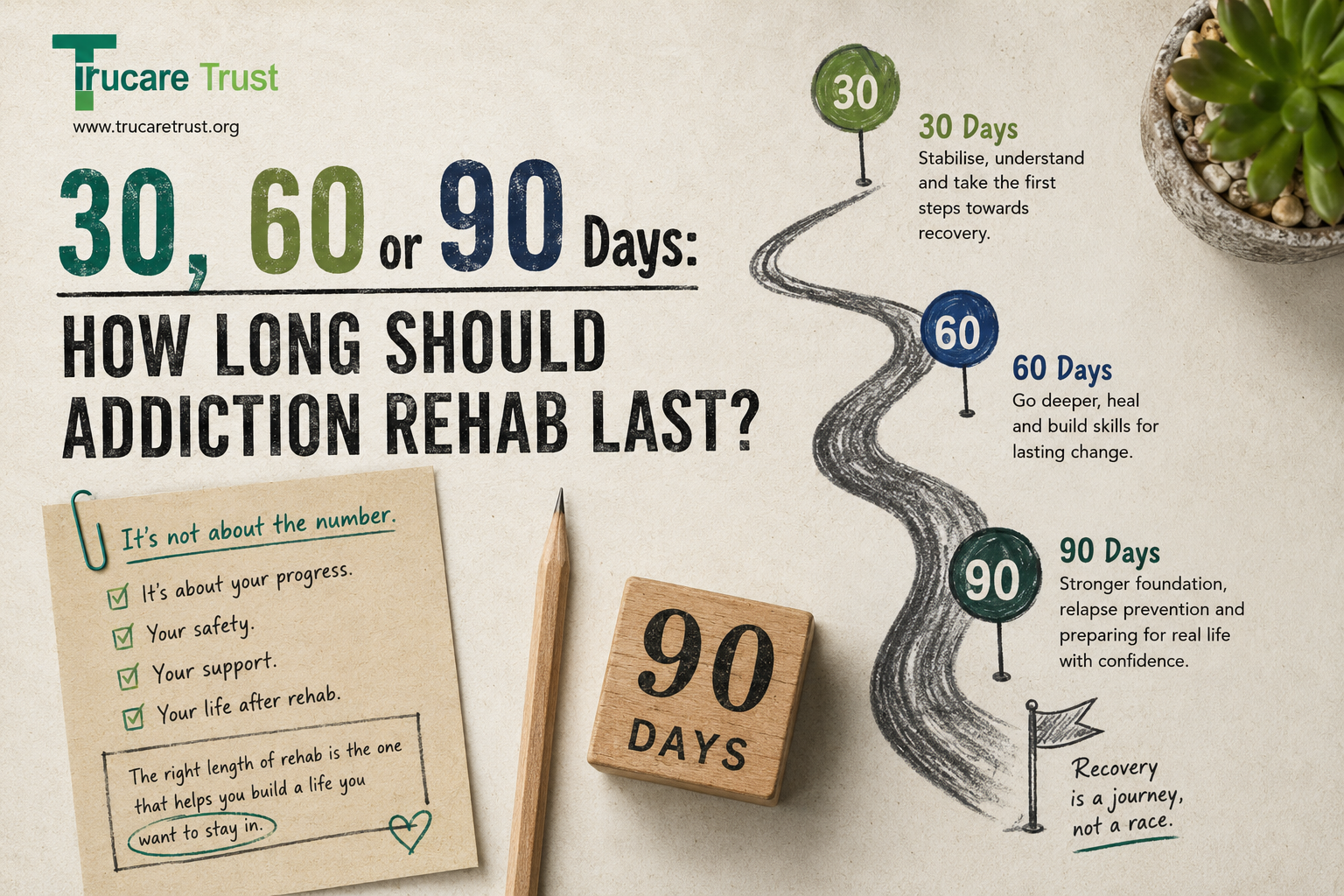
How long does rehab last? There is no safe single answer for every person. A 30-day stay may help with assessment, withdrawal care and an early recovery plan. Some people need 60 days to practise new skills and work on deeper problems. Others may benefit from 90 days or longer, especially after repeated relapses or when home is not yet safe. At a rehabilitation centre in Mumbai, the planned stay should be reviewed as treatment progresses. The right rehabilitation treatment duration depends on health, addiction severity, response to care and support after discharge—not on a package name alone.
| Planning period | What it may allow | When it may be too short |
|---|---|---|
| 30-day rehab | Assessment, withdrawal care where needed, early therapy, a stable routine and initial discharge planning. | When withdrawal takes longer, health or mental health problems remain unstable, insight is limited or the return home is unsafe. |
| 60-day rehab | More time to understand triggers, practise coping skills, involve the family and observe progress beyond the first stable weeks. | When the person has repeated relapses, severe dependence, several linked problems or very limited support outside treatment. |
| 90-day rehab | A longer period for behaviour change, relapse-prevention work, daily responsibility and a gradual plan for life after residential care. | It may still be insufficient when serious risks remain. It may also be more residential care than another person needs if safe step-down care is ready. |
| Longer or continuing care | Extended residential support or a move through outpatient care, medicines where appropriate, counselling, peer support and follow-up. | The plan becomes weak if time is extended without clear goals, regular reviews or a route towards greater independence. |
Why one fixed number does not work
Addiction affects far more than substance use. It can alter sleep, mood, judgement, health, relationships, work and the way a person handles stress. These changes do not settle at the same speed. Withdrawal may improve within days, while learning to manage urges, repair trust and build a workable routine can take much longer.
The length of stay in rehab should therefore reflect the work still needed. One person may enter treatment early, have stable health and return to a supportive home. Another may have years of heavy use, previous seizures, depression, debt, damaged relationships and several failed attempts to stop. Giving both people the same discharge date would ignore important differences.
Modern placement guidance supports this individual approach. The ASAM Criteria explains that care should respond to a person’s progress and changing needs instead of being controlled by a preset period such as a 28-day programme. Its assessment considers withdrawal risk, physical health, mental and cognitive health, readiness for change, risk of continued use, and the recovery environment.
A planned date is useful. Families need to organise leave, work, childcare and money. The date should be treated as a review point rather than a promise made before a proper assessment. A clinical review may support discharge, a longer stay or a move to a less intensive form of care.
What thirty days can and cannot achieve
A 30-day rehab programme can be meaningful. It may allow time for a full assessment, supervised withdrawal care, regular food and sleep, early individual and group sessions, and a basic relapse-prevention plan. For someone who sought help early and has a safe home, it may form the residential part of a longer care plan.
Thirty days can pass quickly. If the first week is spent managing withdrawal, poor sleep or confusion, fewer weeks remain for therapy. A person may only begin to recognise patterns near the end of the month. Family issues may still be unresolved, and the outpatient plan may not yet have been tested.
A 30-day rehab should not be described as a complete cure. It is more useful to ask what has changed during those days. Has the person begun taking responsibility? Can triggers be named without blaming others? Are mood and sleep stable enough for the next level of care? Is there a realistic home plan? Has follow-up been booked rather than merely suggested?
Shorter care may also be chosen because of work, family duties or cost. Those limits are real. When a longer residential stay is not possible, the answer should be a stronger step-down plan, not a claim that thirty days must be enough. The family may find it helpful to compare the costs included in residential rehabilitation with the cost and availability of continuing care.
What an extra month may add
A 60-day rehab programme gives early gains more time to become habits. The person may be steadier and better able to take part in therapy. Counsellors can move beyond the crisis and work on relationships, grief, anger, shame or boredom. A longer residential treatment length also gives the team more time to observe change.
The second month can reveal problems hidden by the relief of the first few weeks. Motivation may rise and fall. A disagreement, difficult family call or strong urge can show whether coping skills hold under pressure. These moments are not necessarily treatment failures. They give the team useful information while support is close.
A 60-day rehab stay can also allow more family work. Relatives have time to understand the difference between support and control. The household can agree on access to money, contact with high-risk people, prescribed medicines, work expectations and what happens if warning signs return.
Sixty days is not automatically better than thirty. Residential care should continue because there are clear goals and risks that require it. Keeping a stable person at a high level of restriction without a clinical reason can delay the practice of recovery in normal life. This is why progress reviews and a planned step-down matter.
When a longer stay deserves serious consideration
A 90-day rehab programme provides a broader window for change. The National Institute on Drug Abuse treatment principles notes that participation for less than 90 days in residential or outpatient care is often of limited effectiveness, and that longer treatment tends to produce better outcomes. This should be understood as evidence for enough total treatment, not a rule that every patient must remain in residential care for exactly three months.
For some people, the full 90-day rehab period may take place in a live-in programme. For others, it may combine residential care with day treatment, outpatient counselling or another structured service. The correct mix depends on safety, progress and the support available outside.
A longer stay deserves close consideration when addiction has continued for years, substance use is heavy or frequent, or earlier treatment ended in rapid relapse. It may also be helpful when the person uses several substances, has an untreated mental health condition, lacks stable housing or will return to a home where substances are widely used.
Time alone does not heal addiction. Ninety days without clear goals, skilled care or discharge planning can become a long pause. Effective long-term rehabilitation gives each phase a purpose, such as improving emotional control, treating a mental health concern or testing a relapse-prevention plan.
Which factors should shape the decision
A recommendation draws from several areas. No single factor decides the addiction treatment period on its own.
The substance and withdrawal history
The substance used can change the early risks and the pace of recovery. Alcohol and sedative withdrawal may require close medical care. Opioid treatment may include medicines and longer follow-up. Stimulant use can be followed by disturbed sleep, low mood or strong urges. The last dose, amount, pattern of use and past withdrawal events all matter.
A history of seizures, delirium, overdose or severe withdrawal raises concern. A website or package description cannot decide whether withdrawal is safe. If someone has a seizure, severe confusion, hallucinations, breathing difficulty, collapse, chest pain or a risk of self-harm, call 112 or go to the nearest emergency department.
Severity and length of the addiction
A recent harmful pattern is different from years of dependence. Loss of control, daily use, failed efforts to stop, strong cravings and continuing despite serious harm point to greater need. Severe problems often require more time and more than one form of support.
The number of years is not a verdict. A long history does not mean recovery is impossible. It does mean that routines, relationships and ways of coping may be deeply tied to the addiction. Changing them usually takes repeated practice.
Physical and mental health
Liver disease, diabetes, pain, poor nutrition, sleep problems or other health concerns can complicate care. Depression, anxiety, trauma, bipolar disorder, psychosis, attention problems and cognitive changes may also affect progress. Treatment should address these needs together rather than assuming every symptom will disappear after substance use stops.
Medication may need time to be reviewed. Mood and thinking can also change after withdrawal. A discharge decision made during a brief period of improvement may be premature if major symptoms remain unstable.
Past treatment and relapse pattern
Previous treatment is useful information, not proof that the person cannot recover. The review should identify what helped, what was missing and what happened before the return to use. Perhaps care ended after detox. Follow-up may not have begun. The person may have returned to the same social group or stopped medicine without medical advice.
Repeated rapid relapses often support a longer and more structured plan. The aim is not punishment for returning to use. More time may allow a different treatment approach, stronger transition planning and work on risks that were overlooked earlier.
Readiness and participation
Agreement to enter rehab does not always mean full acceptance of the problem. Motivation can change from day to day. Useful signs include honest participation, growing responsibility, willingness to consider feedback and active work on a plan for risky situations.
Attendance alone is not enough. A person can complete every scheduled session while avoiding the issues most linked with relapse. Equally, an angry or doubtful start does not mean treatment will fail. The pattern across time matters more than a single difficult day.
Life outside the centre
The home setting has a direct effect on discharge safety. Stable housing, supportive relatives and access to follow-up can make earlier step-down possible. Violence, easy access to substances, active use by household members or pressure to return to an unsafe job can increase risk.
Living alone is not automatically unsafe, and living with family is not automatically protective. The relevant question is whether the setting supports the care plan. Practical matters include transport to appointments, control of prescribed medicines, daily structure and someone appropriate to contact during a crisis.
More than one addiction
Alcohol or drug use may occur with gambling, gaming, compulsive internet use or misuse of prescribed medicines. Treating only the most visible problem can leave another route to the same cycle of secrecy, urge and short-term relief.
Behavioural addictions do not usually need medical detox, but they can still involve debt, sleep loss, conflict, depression and poor control. The rehabilitation treatment duration should allow the whole pattern to be assessed and a practical plan to be put in place.
How progress should be reviewed
Calendar time is easy to count. Recovery progress needs a broader view. Reviews may consider physical stability, sleep, mood, cravings, participation, insight, behaviour with others, ability to follow a routine and readiness for the next setting.
| Area | Signs of useful progress | Reasons for more work or support |
|---|---|---|
| Health | Withdrawal has settled, medicines are understood and major health needs have a plan. | Unstable symptoms, poor medicine adherence or unresolved medical risk. |
| Understanding | The person can describe personal triggers, consequences and early warning signs. | Persistent denial, major gaps in memory or blame without any self-review. |
| Skills | Coping methods have been used during stress, not merely listed in a notebook. | Strong urges repeatedly lead to impulsive action or withdrawal from treatment. |
| Daily life | Sleep, self-care, responsibilities and respectful behaviour are becoming steadier. | Severe mood shifts, aggression, isolation or inability to manage basic routines. |
| Home plan | Follow-up, living arrangements, family roles and crisis steps are clear. | A high-risk return setting, no continuing care or unresolved access to substances. |
No list can predict relapse with certainty. These points help the team judge whether residential care is still needed and what support should follow. A good review also includes the patient’s view. Treatment done entirely to a person, without meaningful participation, is unlikely to build independent recovery.
When is step-down safer than an abrupt end?
Residential discharge should not mean that treatment stops. The WHO and UNODC international treatment standards describe care across different settings. A step-down lowers the intensity while keeping support in place. Depending on local services and clinical needs, it may include outpatient appointments, counselling, support groups, medicine reviews, family sessions and a structured daily routine.
The length of stay in rehab may cover more than one setting, while the residential treatment length may be shorter than the full course. This helps families plan the addiction recovery duration more accurately. A person might spend several weeks in live-in care and then continue treatment for months. Another person may need a longer residential phase before that transition is safe.
Preparation should be specific. The first appointment needs a date. The person should know whom to contact when urges rise. Medicines should be supplied and reviewed safely. High-risk contacts, money access and transport need an agreed plan. General advice to “stay strong” is not a discharge plan.
Families unfamiliar with live-in treatment can review what happens during an inpatient rehab programme. This helps separate the residential phase from detox alone and from the continuing care that follows.
What if the person wants to leave early?
Wanting to leave is common, especially after the immediate crisis settles. The person may miss home, dislike rules, worry about work, feel ashamed or believe the problem is now under control. Strong urges, conflict or fear of difficult therapy can also drive the decision.
The response should begin with understanding the reason. Threats, humiliation or automatic punishment can close communication. The team can assess current risk, explain what remains unfinished and see whether a change in the treatment plan would address a genuine concern.
An adult’s rights, consent and decision-making capacity must be respected within Indian law and clinical practice. If mental illness, severe withdrawal, intoxication or immediate danger affects capacity or safety, qualified medical and legal guidance may be needed. Families should not use force or unlawful confinement.
If early discharge still occurs, harm can be reduced through rapid follow-up, a safe place to stay, medicine guidance, overdose-risk education where relevant and a clear emergency plan. Leaving early raises concern, but it should not end access to care.
Questions that deserve clear answers
Before agreeing to a programme, a family should receive an explanation of how the duration was chosen. The centre should describe when reviews take place, who joins them and what may support discharge, extension or step-down.
The written plan should show whether detox days are included in the quoted period, which clinical services are available and what happens if hospital treatment is required. Fees for extending or shortening the stay, refund terms and the cost of follow-up also need to be clear.
Discharge planning deserves equal attention. The family needs to know what continuing care is expected, who will provide it and how quickly it begins. A recommendation for several more months of care is only useful when the type, frequency and purpose of that care are stated.
The most reassuring answer is not a guarantee of recovery. It is a transparent explanation based on assessment, regular progress reviews and a safe transition. Claims that every person is cured in a fixed number of days should be treated with caution.
Frequently asked questions
Is one month in rehab enough?
One month may be enough for the residential phase of care for some people, especially when risks are lower and strong follow-up is ready. For others, it mainly covers stabilisation and early therapy. The person’s progress and needs should decide what happens next.
Is three months the ideal period for everyone?
No. Evidence supports staying in treatment long enough, and many people benefit from at least three months of total structured care. That does not mean every person needs three full months inside a residential centre. Care may continue at a lower level when it is safe.
Does relapse mean the earlier treatment was too short?
Not always. A short or incomplete course can contribute, but relapse can also relate to untreated mental health needs, weak follow-up, high-risk living conditions or stopping medicines. The next plan should study the pattern rather than simply repeat the same programme.
What is a typical stay for alcohol addiction?
When families ask how long does rehab last for alcohol addiction, the answer depends on withdrawal risk, drinking history, health, past care and support at home. Detox may take days, but rehab and follow-up take longer. Some people step down after several weeks. Others need a longer stay.
What is a typical stay for drug addiction?
There is no single drug rehab timeline. The substance, pattern of use, overdose history, need for medicines, physical and mental health, and recovery setting all affect the plan. Total treatment often continues well beyond residential discharge.
The practical conclusion
Thirty, sixty and ninety days are useful planning points, but none is a universal answer. A 30-day programme may begin the work. A 60-day programme may give skills and family plans more time to develop. A 90-day programme or longer course may be appropriate when needs are severe, repeated or complex.
The better question is what care is required now, what progress has occurred and what support will be ready next. The addiction recovery duration should follow those needs. Long-term rehabilitation then becomes a connected process rather than a fixed stay followed by an abrupt return home.