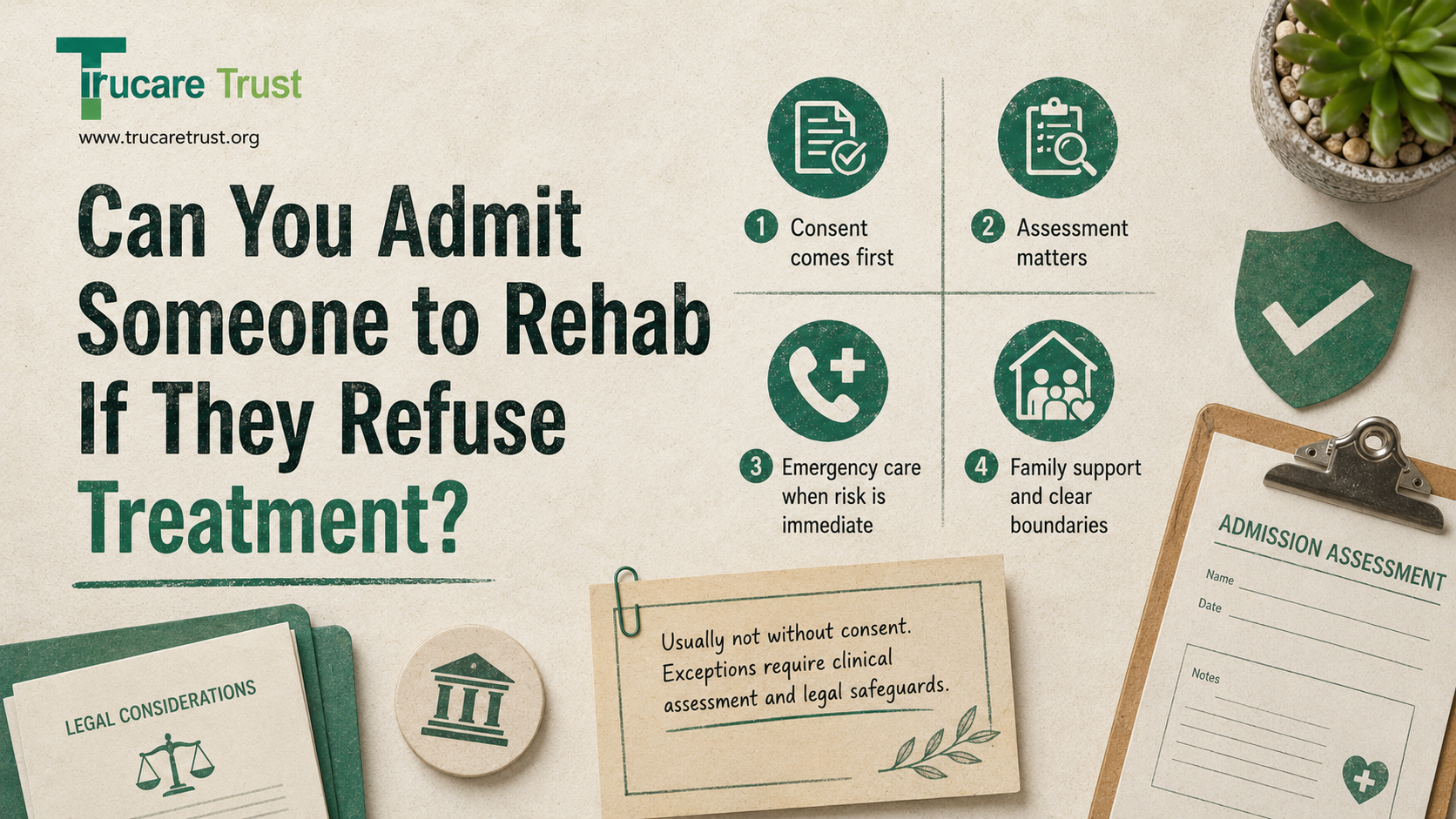
When a person refuses help, families often ask whether admission can happen without consent. Anyone searching for a nasha mukti kendra in Mumbai should know that an adult who can understand and decide about treatment cannot usually be placed in residential rehab simply because relatives insist. Refusal is not the same as incapacity. The safer route is a professional assessment, a planned family conversation and clear boundaries. Supported admission is limited to situations covered by Indian mental-health law, with clinical review, safeguards and the least restrictive care. Immediate danger or severe withdrawal needs emergency medical care.
The short answer
A family cannot ordinarily admit someone to rehab against the wishes of an adult who has decision-making capacity. A relative’s signature does not automatically replace the person’s consent. Different rules may apply when severe mental illness leaves the person unable to make mental-healthcare decisions and there is a serious risk of harm or inability to care for basic safety. Those situations require formal clinical assessment and the safeguards provided by Indian law.
If there is no immediate danger, the practical goal is engagement: understand the refusal, reduce conflict, offer a professional assessment and set boundaries that the family can maintain.
Why a person may reject help even when the harm looks obvious
Denial is only one possible reason for refusing rehabilitation. Shame, fear of being judged, worries about job loss, concern about confidentiality and earlier bad experiences with treatment can all shape the answer. Some people expect a centre to be punitive. Others believe admission means losing contact with family or remaining inside for an unknown period. A person may also be intoxicated, withdrawing, depressed, suspicious or unable to think clearly during the conversation.
This is why the label “unwilling” tells only part of the story. Before seeking rehabilitation for someone who is unwilling to enter treatment, the family needs to understand what the person is resisting. Is it all help, residential admission, a particular centre, the proposed duration or the way the subject was raised? Each answer calls for a different response.
Consent remains the starting point for ordinary admission
Informed consent means more than obtaining a signature. The person should receive understandable information about the proposed care, likely benefits, material risks, alternatives, expected rules, privacy limits, cost and the right to ask questions. Consent should be voluntary and given by someone able to understand the decision and its reasonably foreseeable consequences.
The joint WHO–UNODC International Standards for the Treatment of Drug Use Disorders describe evidence-based and ethical treatment systems. They state that informed consent should be obtained before treatment and that patients should be able to withdraw from treatment. The standards also explain that work with the family can help when a person refusing treatment does not yet participate in care. These principles treat substance use disorders as health conditions while protecting dignity and autonomy.
Consent for rehabilitation is therefore an ongoing process, not paperwork completed at the gate. A person may agree to assessment but not residential admission. Someone may accept detoxification but remain unsure about continuing therapy. Staff should explain each stage and record the person’s decisions rather than assuming one signature covers every future intervention.
Families sometimes ask how to admit someone to rehab after months of failed requests. The ordinary route is still voluntary admission. Parents, spouses and adult children can provide information, arrange an appointment and help with logistics, but they do not automatically gain authority over another adult’s healthcare choices.
What Indian mental-health law changes—and what it does not
Online discussions about forcing a person into rehab in India often merge several different situations. Voluntary residential addiction care, emergency medical treatment and supported admission under mental-health law are not interchangeable. A private family decision cannot substitute for the clinical findings and legal safeguards required for supported admission.
The Mental Healthcare Act, 2017 says that admissions should, as far as possible, be independent admissions. An adult seeking independent admission must understand the nature and purpose of admission and request it of free will. The Act also recognises supported admission for a person with mental illness who has high support needs, but only when detailed conditions are met.
Under Section 89, supported admission for up to 30 days requires independent examinations by specified professionals. They must conclude that the mental illness is severe enough to involve recent threats or attempts of bodily harm, violent behaviour or inability to care for oneself to a degree that creates a risk of harm. Admission must be the least restrictive available option. The person must also be unable to make mental-healthcare decisions independently and need very high support from a nominated representative.
Admission beyond 30 days falls under Section 90 and carries further assessment and review requirements. It is not an automatic extension chosen by the centre or family. The law also provides review mechanisms and requires discharge when the qualifying conditions no longer apply. This is why involuntary addiction treatment cannot be presented as a normal shortcut when persuasion fails.
Supported admission under Sections 89 and 90 takes place through a mental-health establishment and the formal process prescribed by the Act. An unregistered residential facility or private collection agent cannot create this authority through a family consent form. The Act defines mental-health establishments and separately provides for their registration.
Substance use can exist with depression, psychosis, mania, severe cognitive impairment or another mental illness. Yet the presence of addiction does not, by itself, prove that Section 89 or 90 applies. A psychiatrist or other authorised professional must assess the actual condition, decision-making ability, risk and least restrictive option. This article offers general information, not a legal opinion on an individual case.
Disagreement is not the same as loss of decision-making capacity
Under Section 4 of the Mental Healthcare Act, a person is presumed to have capacity when they can understand relevant information, appreciate the reasonably foreseeable consequences of the decision or communicate their decision, after information and support are provided in an accessible form. A decision that relatives or professionals consider harmful does not by itself establish incapacity.
Capacity may fluctuate. Severe intoxication, delirium, withdrawal, psychosis, brain injury or another acute medical condition can temporarily affect thinking. Assessment during such a state should not become a permanent label. Once the immediate condition settles, decision-making ability may need to be reviewed.
Good addiction treatment rights include understandable information, privacy, respect, access to records as allowed by law, participation in treatment decisions and a clear process for complaints or review. A centre should be able to explain how these rights apply during independent admission, supported admission and emergency care.
A family conversation works better when it has one clear purpose
Repeated arguments usually produce repeated answers. A more useful conversation is planned for a time when the person is as sober, calm and medically stable as possible. The purpose is not to win a debate about whether the person “has an addiction”. It is to describe specific harm, offer a realistic next step and explain what the household will no longer manage or conceal.
Begin with events that can be verified: two falls in a month, missed medication, money taken from a joint account, driving after drinking or withdrawal symptoms in the morning. Avoid collecting every painful incident from the past ten years. A long accusation invites a defence of each detail and hides the main safety concern.
A family intervention for addiction should not become a surprise gathering where many relatives corner one person. A small group, a calm setting and agreed language are usually easier to manage. When risk is high or family relationships are volatile, a qualified mental-health professional can help plan the discussion and decide whether it is safe to hold.
Convincing someone to enter rehab is more likely when the person’s own concerns are heard. One person may want better sleep. Another wants to keep a job, repair a marriage or stop withdrawal symptoms. Connecting assessment and treatment to that concern is more useful than demanding agreement with the family’s full explanation of addiction.
Boundaries are different from threats, punishment and control
A boundary states what another family member will do to protect safety, money or children. It does not claim control over the person’s body or healthcare decision. Examples include refusing to provide money that may fund substance use, not allowing intoxicated driving in a family vehicle and moving children away from violent or unsafe behaviour.
Boundaries should be specific, lawful and possible to maintain. “Stop drinking immediately” is a demand. “The children will stay elsewhere when there is violence or severe intoxication at home” is a safety plan. The distinction matters because a family cannot supervise another adult every hour, but it can control its own finances, transport and living arrangements within the law.
For families dealing with years of conflict, structured family therapy in addiction recovery can help separate care from over-responsibility. Family work can continue even when the person using substances is not ready to participate. It can improve safety planning, communication and consistency at home.
When refusal becomes an emergency rather than an admission debate
Some situations require immediate medical help, not another intervention meeting. Suspected overdose, loss of consciousness, slow or difficult breathing, a seizure, severe confusion, hallucinations, chest pain, a serious fall or thoughts of self-harm need urgent assessment. Violent behaviour or a credible threat of bodily harm also requires a safety response. Call 112 in India or go to the nearest emergency department. When there is violence or an immediate threat, move family members to safety and request police or emergency assistance.
Call 112 and follow emergency instructions. Do not attempt private transport when unconsciousness, severe agitation, violence or medical instability could endanger the person, driver or family members. Do not give food, drink or medicines to an unconscious person. India’s 112 system connects emergency requests with police, health, fire and other response services through State and Union Territory systems.
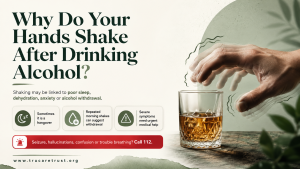
Alcohol withdrawal can become dangerous after drinking stops or falls sharply. Tremors, sweating, vomiting, anxiety and sleeplessness may progress in some people to seizures, hallucinations or delirium. A person who refuses long-term rehab may still need emergency or hospital-based withdrawal care. Medical stabilisation does not automatically authorise a later residential stay without the appropriate consent or legal basis.
Section 94 permits a registered medical practitioner to provide limited emergency treatment when it is immediately necessary to prevent death or irreversible harm, serious harm to the person or others or serious property damage linked directly to mental illness. Where the nominated representative is available, the Act makes this subject to that representative’s informed consent. Emergency treatment can include transport to the nearest mental-health establishment and is generally limited to 72 hours or until the person is assessed there, whichever is earlier. A government-declared disaster or emergency may change the statutory time limit. Section 94 does not authorise indefinite residential detention.
What families in Mumbai should verify before arranging admission
A search for a nasha mukti kendra in Mumbai may produce hospitals, mental-health establishments, counselling clinics, residential programmes and unregistered facilities. These are not legally or clinically identical. The correct setting depends on withdrawal risk, physical illness, mental state, decision-making capacity and the level of supervision required.
Before sharing personal documents or paying a deposit, the family should obtain clear answers to the following points:
- What legal category does the facility operate under and which current registrations apply to its services?
- Who assesses consent, capacity, withdrawal risk, suicide risk and possible co-occurring mental illness?
- How are independent admission, supported admission and emergency transfer handled?
- Which clinicians are available on site and which are available through referral or visits?
- What happens if the person asks to leave, refuses part of the plan or withdraws consent?
- Which restrictions apply to phones, visitors, movement, money and communication, and why?
- How are medical records, confidentiality, medication and complaints managed?
- Which hospital receives a patient when the centre cannot safely manage an emergency?
- How are family meetings, discharge planning and follow-up arranged?
Vague statements such as “the family has signed, so everything is legal” are not enough. A responsible provider should explain the admission route in plain language and document it. These addiction treatment rights should be clear before any payment or transport is arranged. Families should be cautious about agents who promise collection by force, sedation during transport or guaranteed admission without an assessment.
The practical details matter too. Fees, refundable deposits and excluded medical costs should be written down. The earlier guide to rehab costs and treatment charges in India explains why accommodation and medical needs can change the total. Price, however, does not determine whether a proposed admission is lawful or clinically appropriate.
Practices that should raise immediate concern
Locked doors alone do not prove unlawful care; some authorised settings manage genuine risks under specific rules. The concern is a facility that cannot explain the legal basis, clinical reason, review process and patient safeguards behind a restriction. Security should never be used as a substitute for assessment or qualified staffing.
Warning signs include physical punishment, humiliation, forced labour, routine isolation, threats, unexplained sedation, denial of necessary medical care and refusal to provide records or fee terms. A centre should not market forced admission to rehabilitation in India as a standard service available whenever relatives are willing to pay.
Families should also reject plans based on deception. Telling a person that the family is going to a restaurant and then delivering the person to a facility may create panic, resistance and lasting mistrust. In a true emergency, the route is emergency assessment. Outside an emergency, transparent engagement and lawful clinical processes are safer.
Involuntary addiction treatment is sometimes discussed as though confinement itself produces motivation. It does not. A controlled setting may interrupt access to substances, but lasting change requires assessment, therapeutic participation, skills, follow-up and attention to the person’s reasons for change. Detention without lawful grounds is not treatment.
Several common situations need different responses
The person is under 18. Admission of minors has separate rules and added safeguards. A general adult consent discussion should not be applied to a child. The facility should explain the relevant process, specialist assessment and the role of the nominated representative.
The person accepts help but refuses a particular centre. This is not the same as refusing all care. Clarify the concern and compare suitable alternatives. Rehabilitation for someone who is unwilling to enter treatment may become unnecessary when privacy, duration, work, family contact and treatment expectations are discussed honestly.
What happens after the person agrees to an assessment
Treatment length also should not be promised before assessment. Progress, medical needs, relapse history, home conditions and continuing-care arrangements all matter. The series guide on 30-, 60- and 90-day rehabilitation explains why total treatment engagement and residential length are related but not identical.
India’s treatment gap makes respectful engagement more important
The 2019 national substance-use survey, conducted by NDDTC at AIIMS New Delhi for the Ministry of Social Justice and Empowerment, estimated that about 5.7 crore Indians needed help for harmful or dependent alcohol use. It also found that access to treatment was very low. The Government of India’s survey release reported that only about one in 38 people with alcohol dependence had received any treatment.
Frequently asked questions
Can parents or a spouse sign an adult into residential care?
A relative’s signature alone does not usually authorise admission of an adult who has capacity and refuses. Ordinary admission requires consent for rehabilitation from the person. Supported admission requires the assessments, risk criteria, high support needs and safeguards set out in law; it is not created by family preference.
Does repeated substance use prove that the person cannot decide?
No. Addiction may affect judgement, but diagnosis and poor choices do not automatically remove decision-making capacity. Capacity must be assessed for the particular healthcare decision at the relevant time and with suitable support.
Can a centre collect someone from home against that person’s wishes?
A routine paid “pickup” is not a substitute for consent, emergency services or a lawful supported-admission process. Families should ask for the exact clinical and legal basis of any proposed transport. In a medical or safety emergency, trained emergency services are more appropriate than private force.
What can be done when every conversation ends in denial?
A family intervention for addiction can be planned with a qualified professional. Keep the group small, describe recent facts, offer one manageable assessment and state consistent boundaries. Convincing someone to enter rehab may take time; the immediate aim can be agreement to assessment rather than agreement to every part of residential care.
Can someone leave after entering voluntarily?
An independently admitted adult must generally be discharged when they request it. In limited circumstances, discharge may be delayed for up to 24 hours so that professionals can assess whether the legal criteria for supported admission are met. The person must then either be admitted through the lawful supported-admission process or discharged.
When may psychiatric or legal guidance be necessary?
Guidance may be needed when severe mental illness, impaired capacity, recent serious self-harm, violence or inability to maintain basic safety is present. It may also be needed when relatives and a facility disagree about the legal basis for keeping someone admitted. Case-specific advice should come from appropriately qualified clinicians and legal professionals.
Is refusal a reason to give up?
No. Refusing rehabilitation today does not predict every later decision. Family members can improve safety, stop financing harmful behaviour, seek professional guidance for themselves and keep a clear treatment option available. They should not promise secrecy about serious danger or accept violence in the hope of preserving cooperation.
A safer answer to a painful family question
For an adult with capacity, respectful engagement remains the proper starting point. For someone who is medically unstable or in immediate danger, emergency assessment comes first. Where severe mental illness and high support needs may be present, formal professional assessment and the safeguards of the Mental Healthcare Act matter.
Medical and legal note: This article provides general educational information and is not a diagnosis, legal opinion or substitute for individual medical or legal advice. For suspected overdose, severe withdrawal, unconsciousness, seizures, breathing difficulty, serious violence or immediate self-harm risk, call 112 in India or go to the nearest emergency department. The statutory explanations in this article should receive qualified Indian legal review before publication and case-specific legal advice where required.